Page 30 - 2board23full
P. 30
06. Our Business Units
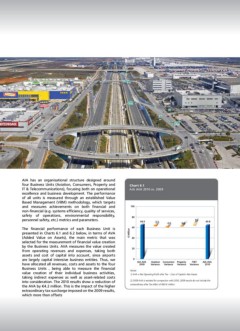
AIA has an organisational structure designed around Chart 6.1
four Business Units (Aviation, Consumers, Property and AIA AVA 2010 vs. 2009
IT & Telecommunications), focusing both on operational
excellence and business development. The performance Notes:
of all units is measured through an established Value 1) AVA = Net Operating Profit after Tax – Cost of Capital x Net Assets
Based Management (VBM) methodology, which targets 2) 2009 AVA is restated for comparison with 2010; 2009 results do not include the
and measures achievements on both financial and extraordinary after Tax effect of €60.6 million.
non-financial (e.g. systems efficiency, quality of services,
safety of operations, environmental responsibility,
personnel safety, etc.) metrics and parameters.
The financial performance of each Business Unit is
presented in Charts 6.1 and 6.2 below, in terms of AVA
(Added Value on Assets), the main metric that was
selected for the measurement of financial value creation
by the Business Units. AVA measures the value created
from operating revenues and expenses, taking both
assets and cost of capital into account, since airports
are largely capital intensive business entities. Thus, we
have allocated all revenues, costs and assets to the four
Business Units , being able to measure the financial
value creation of their individual business activities,
taking indirect expenses as well as asset-related costs
into consideration. The 2010 results show a reduction of
the AVA by €4.2 million. This is the impact of the higher
extraordinary tax surcharge imposed on the 2009 results,
which more than offsets