Page 24 - 2board23full
P. 24
04. Market Overview
Chart 4.10 Cargo Uplift
Quarterly Aircraft Movements Development 2010 In 2010 the global airfreight industry recorded a
significant increase of 20.6% compared to 2009 traffic.
Despite this worldwide recovery to pre-recession levels,
the Greek airfreight market faced yet another turbulent
year. Greece’s continuing financial crisis is evident in
the 7.5% decrease in the volume handled by the airport
which reached 96,676 tonnes.
International imports sank further by 10% due to reduced
consumer demand while the export sector was less
affected and reduced by only 3%. Although a downward
trend was expected for the freight traffic, it is the case
of mail traffic that draws the most attention. For the first
time since the airport’s opening, mail volumes displayed
a decrease. Both domestic and international mail volumes
demonstrated an average 13.5% decline.
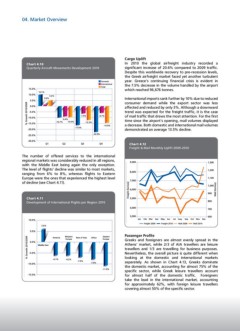
Chart 4.12
Freight & Mail Monthly Uplift 2009-2010
The number of offered services to the international
regional markets was considerably reduced in all regions,
with the Middle East being again the only exception.
The level of flights’ decline was similar to most markets,
ranging from 6% to 8%, whereas flights to Eastern
Europe were the ones that experienced the highest level
of decline (see Chart 4.11).
Chart 4.11
Development of International Flights per Region 2010
Passenger Profile
Greeks and foreigners are almost evenly spread in the
Athens’ market, while 2/3 of AIA travellers are leisure
travellers and 1/3 are travelling for business purposes.
Nevertheless, the overall picture is quite different when
looking at the domestic and international markets
separately. As shown in Chart 4.13, Greeks dominate
the domestic market, accounting for almost 75% of the
specific sector, while Greek leisure travellers account
for almost half of the domestic traffic. Foreigners
take the lead in the international market, accounting
for approximately 62%, with foreign leisure travellers
covering almost 50% of the specific sector.