Page 65 - 2board23full
P. 65
2011
f) Liquidity risk
Liquidity risk is the risk that the entity will have difficulty in raising the financial resources required to fulfil its commitments.
Liquidity risk is held at low levels through effective cash flow management and availability of adequate cash. Cash flow
forecasting is performed internally by rolling forecasts of the Company’s liquidity requirements to ensure that is has
sufficient cash to meet operational needs, to fund scheduled investments and debt and to comply with loan covenants.
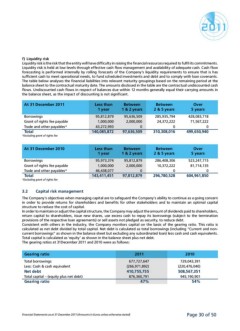
The table below analyses the financial liabilities into relevant maturity groupings based on the remaining period at the
balance sheet to the contractual maturity date. The amounts disclosed in the table are the contractual undiscounted cash
flows. Undiscounted cash flows in respect of balances due within 12 months generally equal their carrying amounts in
the balance sheet, as the impact of discounting is not significant.
At 31 December 2011 Less than Between Between Over
1 year 1 & 2 years 2 & 5 years 5 years
Borrowings 95,812,879 95,636,509 285,935,794 428,083,718
Grant of rights fee payable 1,000,000 2,000,000 24,372,222 71,567,222
Trade and other payables* 0 0 0
Total 43,272,993
140,085,872 97,636,509 310,308,016 499,650,940
*Excluding grant of rights fee
At 31 December 2010 Less than Between Between Over
1 year 1 & 2 years 2 & 5 years 5 years
Borrowings 95,973,374 95,812,879 286,408,306 523,247,715
1,000,000 2,000,000 10,372,222 81,714,135
Grant of rights fee payable 0 0 0
46,438,077
Trade and other payables* 143,411,451 97,812,879 296,780,528 604,961,850
Total
*Excluding grant of rights fee
3.2 Capital risk management
The Company’s objectives when managing capital are to safeguard the Company’s ability to continue as a going concern
in order to provide returns for shareholders and benefits for other stakeholders and to maintain an optimal capital
structure to reduce the cost of capital.
In order to maintain or adjust the capital structure, the Company may adjust the amount of dividends paid to shareholders,
return capital to shareholders, issue new shares, use excess cash to repay its borrowings (subject to the termination
provisions of the respective loan agreements) or sell assets not pledged as security, to reduce debt.
Consistent with others in the industry, the Company monitors capital on the basis of the gearing ratio. This ratio is
calculated as net debt divided by total capital. Net debt is calculated as total borrowings (including “Current and non-
current borrowings” as shown in the balance sheet but excluding any subordinated loan) less cash and cash equivalents.
Total capital is calculated as ‘equity’ as shown in the balance sheet plus net debt.
The gearing ratios at 31December 2011 and 2010 were as follows:
Gearing ratio 2011 2010
Total borrowings 677,727,647 729,043,391
Less: Cash & cash equivalent (266,971,892) (220,476,040)
Net debt 410,755,755 508,567,351
Total capital – (equity plus net debt)
Gearing ratio 876,360,791 945,190,901
47% 54%
Financial Statements as at 31 December 2011 (Amounts in Euros unless otherwise stated) Page 30 of 50
f) Liquidity risk
Liquidity risk is the risk that the entity will have difficulty in raising the financial resources required to fulfil its commitments.
Liquidity risk is held at low levels through effective cash flow management and availability of adequate cash. Cash flow
forecasting is performed internally by rolling forecasts of the Company’s liquidity requirements to ensure that is has
sufficient cash to meet operational needs, to fund scheduled investments and debt and to comply with loan covenants.
The table below analyses the financial liabilities into relevant maturity groupings based on the remaining period at the
balance sheet to the contractual maturity date. The amounts disclosed in the table are the contractual undiscounted cash
flows. Undiscounted cash flows in respect of balances due within 12 months generally equal their carrying amounts in
the balance sheet, as the impact of discounting is not significant.
At 31 December 2011 Less than Between Between Over
1 year 1 & 2 years 2 & 5 years 5 years
Borrowings 95,812,879 95,636,509 285,935,794 428,083,718
Grant of rights fee payable 1,000,000 2,000,000 24,372,222 71,567,222
Trade and other payables* 0 0 0
Total 43,272,993
140,085,872 97,636,509 310,308,016 499,650,940
*Excluding grant of rights fee
At 31 December 2010 Less than Between Between Over
1 year 1 & 2 years 2 & 5 years 5 years
Borrowings 95,973,374 95,812,879 286,408,306 523,247,715
1,000,000 2,000,000 10,372,222 81,714,135
Grant of rights fee payable 0 0 0
46,438,077
Trade and other payables* 143,411,451 97,812,879 296,780,528 604,961,850
Total
*Excluding grant of rights fee
3.2 Capital risk management
The Company’s objectives when managing capital are to safeguard the Company’s ability to continue as a going concern
in order to provide returns for shareholders and benefits for other stakeholders and to maintain an optimal capital
structure to reduce the cost of capital.
In order to maintain or adjust the capital structure, the Company may adjust the amount of dividends paid to shareholders,
return capital to shareholders, issue new shares, use excess cash to repay its borrowings (subject to the termination
provisions of the respective loan agreements) or sell assets not pledged as security, to reduce debt.
Consistent with others in the industry, the Company monitors capital on the basis of the gearing ratio. This ratio is
calculated as net debt divided by total capital. Net debt is calculated as total borrowings (including “Current and non-
current borrowings” as shown in the balance sheet but excluding any subordinated loan) less cash and cash equivalents.
Total capital is calculated as ‘equity’ as shown in the balance sheet plus net debt.
The gearing ratios at 31December 2011 and 2010 were as follows:
Gearing ratio 2011 2010
Total borrowings 677,727,647 729,043,391
Less: Cash & cash equivalent (266,971,892) (220,476,040)
Net debt 410,755,755 508,567,351
Total capital – (equity plus net debt)
Gearing ratio 876,360,791 945,190,901
47% 54%
Financial Statements as at 31 December 2011 (Amounts in Euros unless otherwise stated) Page 30 of 50