Page 64 - 2board23full
P. 64
Financial Statements
The remaining balance of trade and other receivables mainly comprises accrued property rentals and is not subject to
impairment testing.
Any past due account that is fully covered by guarantees or collaterals given is not tested for impairment.
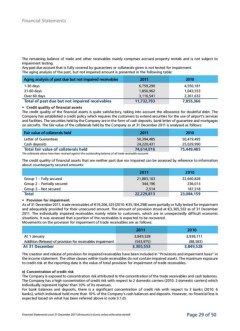
The aging analysis of the past, but not impaired amount is presented in the following table:
Aging analysis of past due but not impaired receivables 2011 2010
1-30 days 6,759,290 4,550,181
31-60 days 1,856,962 1,043,553
Over 60 days 3,116,541 2,261,632
Total of past due but not impaired receivables 11,732,793 7,855,366
• Credit quality of financial assets
The credit quality of the financial assets is quite satisfactory, taking into account the allowance for doubtful debt. The
Company has established a credit policy which requires the customers to extend securities for the use of airport’s services
and facilities. The securities held by the Company are in the form of cash deposits, bank letter of guarantee and mortgages
on aircrafts. The fair value of the collaterals held by the Company as at 31 December 2011 is analysed as follows:
Fair value of collaterals held 2011 2010
Letter of Guarantees 50,394,485 50,419,495
25,029,990
Cash deposits 24,220,431 75,449,485
Total fair value of collaterals held 74,614,916
The collaterals above have been received against the outstanding balance of all trade receivable accounts
The credit quality of financial assets that are neither past due nor impaired can be assessed by reference to information
about counterparty secured amounts:
2011 2010
Group 1 – Fully secured 21,883,103 22,660,828
Group 2 – Partially secured 344,196 236,013
Group 3 – Not secured 2,514 187,318
Total
22,229,813 23,084,159
• Provision for impairment
As of 31 December 2011, trade receivables of €19,206,325 (2010: €35,184,298) were partially or fully tested for impairment
and adequately provided for their unsecured amount. The amount of provision stood at €3,305,553 as of 31 December
2011. The individually impaired receivables mainly relate to customers, which are in unexpectedly difficult economic
situations. It was assessed that a portion of the receivables is expected to be recovered.
Movements on the provision for impairment of trade receivables are as follows:
2011 2010
At 1 January 3,849,528 3,938,111
Addition (Release) of provision for receivables impairment (543,975) (88,583)
At 31 December 3,305,553 3,849,528
The creation and release of provision for impaired receivables have been included in “Provisions and impairment loses” in
the income statement. The other classes within trade receivables do not contain impaired assets. The maximum exposure
to credit risk at the reporting date is the value of total provision for impairment of trade receivables.
e) Concentration of credit risk
The Company is exposed to concentration risk attributed to the concentration of the trade receivables and cash balances.
The Company has a high concentration of credit risk with respect to 2 domestic carriers (2010: 2 domestic carriers) which
individually represent higher than 10% of its revenues.
For bank balances and deposits, there is a significant concentration of credit risk with respect to 3 banks (2010: 6
banks), which individual hold more than 10% of the Company’s cash balances and deposits. However, no financial loss is
expected based on what has been referred above in note 3.1.d).
Financial Statements as at 31 December 2011 (Amounts in Euros unless otherwise stated) Page 29 of 50
The remaining balance of trade and other receivables mainly comprises accrued property rentals and is not subject to
impairment testing.
Any past due account that is fully covered by guarantees or collaterals given is not tested for impairment.
The aging analysis of the past, but not impaired amount is presented in the following table:
Aging analysis of past due but not impaired receivables 2011 2010
1-30 days 6,759,290 4,550,181
31-60 days 1,856,962 1,043,553
Over 60 days 3,116,541 2,261,632
Total of past due but not impaired receivables 11,732,793 7,855,366
• Credit quality of financial assets
The credit quality of the financial assets is quite satisfactory, taking into account the allowance for doubtful debt. The
Company has established a credit policy which requires the customers to extend securities for the use of airport’s services
and facilities. The securities held by the Company are in the form of cash deposits, bank letter of guarantee and mortgages
on aircrafts. The fair value of the collaterals held by the Company as at 31 December 2011 is analysed as follows:
Fair value of collaterals held 2011 2010
Letter of Guarantees 50,394,485 50,419,495
25,029,990
Cash deposits 24,220,431 75,449,485
Total fair value of collaterals held 74,614,916
The collaterals above have been received against the outstanding balance of all trade receivable accounts
The credit quality of financial assets that are neither past due nor impaired can be assessed by reference to information
about counterparty secured amounts:
2011 2010
Group 1 – Fully secured 21,883,103 22,660,828
Group 2 – Partially secured 344,196 236,013
Group 3 – Not secured 2,514 187,318
Total
22,229,813 23,084,159
• Provision for impairment
As of 31 December 2011, trade receivables of €19,206,325 (2010: €35,184,298) were partially or fully tested for impairment
and adequately provided for their unsecured amount. The amount of provision stood at €3,305,553 as of 31 December
2011. The individually impaired receivables mainly relate to customers, which are in unexpectedly difficult economic
situations. It was assessed that a portion of the receivables is expected to be recovered.
Movements on the provision for impairment of trade receivables are as follows:
2011 2010
At 1 January 3,849,528 3,938,111
Addition (Release) of provision for receivables impairment (543,975) (88,583)
At 31 December 3,305,553 3,849,528
The creation and release of provision for impaired receivables have been included in “Provisions and impairment loses” in
the income statement. The other classes within trade receivables do not contain impaired assets. The maximum exposure
to credit risk at the reporting date is the value of total provision for impairment of trade receivables.
e) Concentration of credit risk
The Company is exposed to concentration risk attributed to the concentration of the trade receivables and cash balances.
The Company has a high concentration of credit risk with respect to 2 domestic carriers (2010: 2 domestic carriers) which
individually represent higher than 10% of its revenues.
For bank balances and deposits, there is a significant concentration of credit risk with respect to 3 banks (2010: 6
banks), which individual hold more than 10% of the Company’s cash balances and deposits. However, no financial loss is
expected based on what has been referred above in note 3.1.d).
Financial Statements as at 31 December 2011 (Amounts in Euros unless otherwise stated) Page 29 of 50